Skip to content


Clinical evidence and resources to support your clinical practice

Access clinical evidence, consensus documents, best practice statements and other wound care resources for healthcare professionals designed to support informed clinical decision-making and everyday practice. Download the materials most relevant to your needs or contact us if you require a printed copy or further information. 
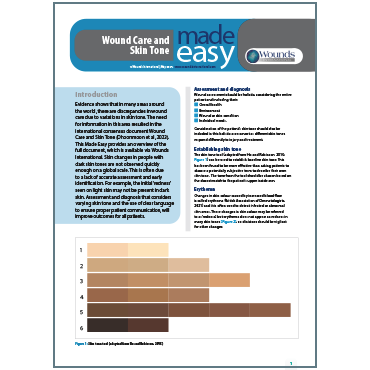
A poster titled “Wound Care and Skin Tone” with an introduction, bullet points, and a brown bar chart.

Wound care and skin tone made easy

A magazine page about skin tears and skin tone with a blue “made easy” header and blocks of text.

Skin tears and skin tone made easy

A medical poster about pressure ulcers with blue and white sections, text columns, and a body diagram showing affected areas.

Pressure ulcers and skin tone made easy

A newspaper or journal page with the headline “Implementation of skin tone assessment in pressure ulcer prevention” and dense article text.

Implementation of skin tone assessment in pressure ulcer prevention

Book cover titled “Wound Care and Skin Tone” with a circular brown-and-white spiral graphic and the Wounds International logo.

International consensus document

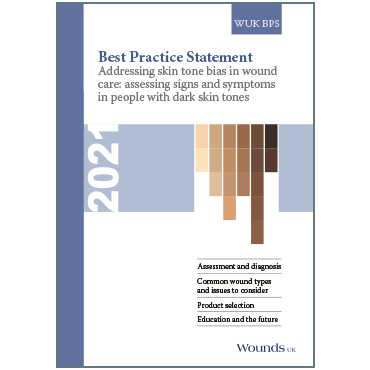
A report cover titled “Best Practice Statement” about addressing skin tone bias in wound care, with a 2021 label and Wounds UK branding.

Skin tone bias in wound care

  1. Serra R, Lelapi N, Barbetta A, de Franciscis S (2018) Skin tears and risk factors assessment: A systematic review on evidence‐based medicine. Int Wound J 15(1): 38-42.

  2. Charbonneau L, Probst S, Gethin G (2022) Prevention and management of skin tears: A survey of nurses in French-speaking Switzerland. Journal of Wound Management 23(2): 78-86.

  3. Dhoonmoon L, Fletcher J, Atkin L et al (2021) Best Practice Statement. Addressing skin tone bias in wound care: assessing signs and symptoms in people with dark skin tones. Wounds UK https://wounds-uk.com/wp-content/uploads/2023/02/191ac9b79f47de2896cf1a30f39037f5.pdf

  4. Tadesse, GA, Cintas, C, Varshney, KR et al. (2023) Skin Tone Analysis for Representation in Educational Materials (STAR-ED) using machine learning. npj Digit. Med. 6, 151.

  5. LeBlanc K, Dhoonmoon L, Samuriwo R (2024) Skin tears and skin tone. Wounds International. https://woundsinternational.com/made-easy/skin-tears-and-skin-tone/

  6. Mukwende M (2020) Mind the Gap: A clinical handbook of signs and symptoms in black and brown skin. Wounds UK 16(3): 16. https://wounds-uk.com/journal-articles/mind-gap-clinical-handbook-signs-and-symptoms-black-and-brown-skin/

  7. adapted from: Ho BK, Robinson JK (2015) Color bar tool for skin type self-identification: A cross-sectional study. J Am Acad Dermatol. 73(2):312-3.e1. doi:10.1016/j.jaad.2015.05.024.

  8. Mangan M, Shoreman S (2021) Empowering residential care home staff to manage patients with skin tears: reducing the need for unscheduled district nursing visits. Wounds UK 17(3): 44-50.

  9. LeBlanc, K, Baranoski, S et al (2011) Skin Tears: State of the Science: Consensus Statements for the Prevention, Prediction, Assessment, and Treatment of Skin Tears. Advances in Skin and Wound Care.24(9S).

  10. LeBlanc K, Campbell K, Beeckman D et al (2018) Best practice recommendations for the prevention and management of skin tears in aged skin. Wounds International.

  11. The International Skin Tear Advisory Panel (ISTAP) is committed to increasing global awareness about skin tear prevention, assessment, and management. With a membership exceeding 4,000 healthcare professionals worldwide, ISTAP focuses on improving patient outcomes through education, research, and advocacy. ISTAP’s Skin Tear Consensus Panel, consists of international experts, which developed comprehensive guidelines for the prevention and treatment of skin tears.

  12. Van Tiggelen H, Beeckman D (2022) Skin tears anno 2022: An update on definition, epidemiology, classification, aetiology, prevention and treatment. Journal of Wound Management 23(2): 38-51.

  13. Beeckman D, Campbell K, LeBlanc K et al (2020) Best practice recommendations for holistic strategies to promote and maintain skin integrity. Wounds International. https://woundsinternational.com/wp-content/uploads/2023/02/3030301f766e16fe15684829ac4f20e4.pdf

  14. LeBlanc K, Baranoski S (2017) Skin tears: Finally recognized. Adv Skin Wound Care 30(2): 62-3.